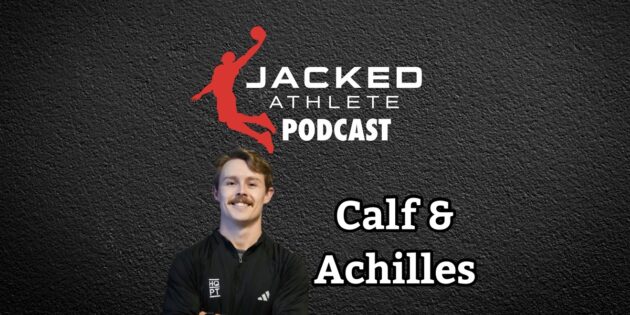
“The calf and Achilles area is very biomechanics heavy.”
“The foot is very close to the ground so any ground reaction forces that come through the foot are likely going to go through the foot and ankle.”
“In my opinion, the further you get up the the quote-unquote kinetic chain, you know, it’s pretty hard to understand the exact amount of force that’s going through the L4 facet joint because it’s so high up and there’s so many other variables that can dissipate that load beforehand. But considering it’s like the ankle joint, it’s the calf that’s directly close to the ground.”
“What I’ve seen with some people that have a hard time using their calf, they don’t have that kind of reactive strength that pop off the floor… And so they may have that capacity, but it may just be pain that’s limiting them or something like that. So they will tend to push off with like a, in a relatively like dorsiflex position.”
“That very last forceful toe-off from the calves in that very end stage of the counter movement jump is one of the largest contributors to peak power and peak takeoff velocity. People that don’t use their calves well, they’ll kind of push off in a relatively dorsiflexed position.”
“When it comes to deceleration, it’s really hard to tell whether or not you’re using your calves or not.”
“You can see if somebody doesn’t have a quad and also doesn’t have a calf, they’ll try and decelerate and immediately get up onto their toes. And then they kind of do that weird little stutter step with that front foot where they don’t have enough impulse to break their momentum, so then they have to do that extra little hop step with that front foot… They went through all stops of the hip, the knee, and the ankle trying to decelerate their body mass, but none of those three were sufficient enough, so then they had to take that extra step to put that foot further out in front of them so that they could essentially reorient their ground reaction forces.”
Calf anatomy: “I think the main characteristics that you have to look at when differentiating muscles are the fiber type, fiber length, presence or lack of non-contractile structures (i.e. epineuroses or intramuscular tendons), and then force characteristics (soleus is about 80 % oxidative type 1, gastroc is more of a 50-50 distribution).”
Soleus being a ‘postural’ muscle: “I think we’d probably question that because if you think of postural muscles, you think low force and we know the soleus can produce an insane amount of force.”
“The soleus muscle fiber lengths themselves are super short. And that is really beneficial when it comes to being efficient with muscle contractions. It doesn’t need to shorten a whole lot to produce a lot of force.”
Soleus: “If we’re trying to be energetically efficient, we’re going to be a lot more oxidative in nature, we’re going to shorten up the muscle fibers, and we’re going to put things, put structures within the muscle that don’t require as much energy. So in non-contractile tissues so that we can stave off some of that kind of energetically demanding contractions like eccentric contractions and those sorts of things. So soleus is a lot more biased towards that kind of quote unquote efficiency ⁓ based on some of those sort of structural characteristics.”
Gastroc: “When it comes to non-contractile tissues within the gastrocs, there’s just two apneuroses… So those are the two apneuroses that sandwich the muscle fibers together. And the muscle fibers themselves in the gastrocs are considerably longer meaning they have to shorten at a faster velocity to produce similar amounts of force. So that kind of biases them more towards that quote unquote fast switch.”
“When you look at some of the running kinetic data and modeling data, you’ll see soleus kind of quote unquote turns on earlier on. It provides a load attenuating contraction where there is negative work being done by the muscle tendon unit and then the more positive work that’s being done by the entirety of the calf and Achilles complex, namely comes from a forceful gastrocs toe off towards the later 50 % of the stance phase. So the way that I kind of say is that the soleus provides a little bit of a springboard for the gastrocs to then take the credit for the really forceful push off.”
“If we then take a muscle strain (no aponeurotic involvement), so long as it’s tolerable, I will likely go quicker into more dynamic activities, whether it’s, you know, sled pushes, whether it’s, you know, like band assisted POGOs or things like that, just so that we can get some of those sorts of ⁓ faster ⁓ reactive strength type qualities back into that muscle because the tissue healing process is likely going to be a little bit accelerated.”
“The second there’s either aponeurosis or intramuscular tendon involvement in a strain injury, we know return to play times are going to be increasingly delayed. So it means that we either need to respect tissue healing time and go a little bit slower.”
“The soleus can take a ton of really high loads and it has really short fibers so it’s incredibly efficient at doing so.”
“The idea of like a certain amount of strain, a percentage of strain, let’s call it 10 % strain for the ease of math. And then let’s say somebody like in a typical person who doesn’t have that balled up gastroc has an Achilles tendon that’s 30 centimeters long. That’s pretty long, but we’ll just say 30 centimeters. 10 % strain of 30 centimeters is three centimeters. So that means they go from 30 to 33 centimeters, right? So that’s three centimeters of strain. If you take the same amount of strain, 10%, but you increase the length of that tendon, and you call it 40 centimeters, well now that three centimeters of strain turns to four centimeters of strain, because 10 % of 40 is 4. When you have that shorter and shorter and shorter muscle belly, you could get the same amount of strain from a percentage or a relative perspective, but absolute amounts of strain are going to be greater… So even if they have the same levels of strain, they could be quote unquote more efficient at using their tendons because there is more strain going through that area.”
“Soleus generally comes on earlier in stance probably just before the 50 % marker of stance phase… soleus has a very similar recruitment pattern to the quads… There is a known mechanism of how soleus and quads are kind of synergists when it comes to that like ground contact deceleration position. So a heuristic that somebody could follow that’s probably not completely accurate, but good enough is soleus is likely helpful for decelerating the shank during that eccentric or quote-unquote eccentric dorsiflexion position and then the gastroc kind of turns on and twitches so that you can get into that you know quick springy plantar flexion drive off.”
“The soleus muscle architectures almost screaming out just don’t give me an eccentric contraction. Like I’m gonna do anything possible to avoid that energetically demanding eccentric contraction.”
“When it comes to the total tensile force production characteristics with soleus, with each step it incurs about 85% of its peak force characteristics or its peak force capacity. People would largely assume from like generic meathead strength and conditioning, 85% is within the strength building percentages of a one rep max area. You’d probably be doing anywhere between four and six or seven reps of that if you’re going hard. So it’s like, okay, cool, we can’t do 80 reps, you know, or like you can’t really do that many of something that’s that hard. ⁓ So what I’m a big fan of when it comes to training the calf is doing things like cluster sets, right? So it allows you to accumulate a little bit more volume ⁓ with heavier loads.”
“Doing a hundred reps with a 15 pound kettlebell on your knee is not going to do anything for you”
Running vs. Lifting: “They’re very different contractions when you’re like doing muscular work versus tendinous work. Work being force times distance, from a physics sense. When you’re going through most speeds of running, it’s going to be an isometric contraction within the calves and then a large stretch shortening cycle amplitude within the Achilles, which is gonna be a lot of the driving force. Then when you think about that, you’re like, okay, well, you’re not doing a whole lot of muscular work within the calf and within the soleus and gastrocs. That’s just clamping down, dumping load into the Achilles and then using that as the propulsive force. So then when you go and like actually have to do a quality eccentric and concentric contraction (when lifting), well, your body’s like, well, I use this muscle, but I don’t use it in this way. And so that’s why it’s difficult.”
Training calves: “You have to approach it like an S&C coach, it’s like trying to periodize a squat plan or something like that in my opinion… People will just say I’ll do a standing calf raise and I’ll do a seated calf raise and I’ll call it a day. Which for some people could very well be the stimulus that they need if they haven’t done anything previously… But if you wanted a super robust plan and if you have two days a week that you have dedicated to training I would say one day would be focused more on like heavy slow stuff and one day would be focused on you know lighter faster stuff.”
“If it’s a heavy slow day, then you’re probably going to do peak force focus things. don’t be afraid to go to failure at rep eight, right, or something like that, or rep six. Doing sets of six calf raises is actually a really helpful thing.”
“I’m a big fan of putting a slant board down in a squat rack so that when you put one foot on it, it biases it towards eversion. So your calcaneus kind of dumps medially, you’re quote unquote pronating, but you’re on your forefoot. That would probably, in theory, deliver a little bit more strain to the medial side of the tendon.”
“If you’re a more advanced individual and like don’t have an injury history doing essentially single leg jumping with a moderately light medium load sled, you will either tear your Achilles or you’ll just make yourself like the strongest calf ever in my opinion. Because being able to exert a lot of force in that kind of acceleration type position and range dorsiflexion pushing against a really heavy or moderately heavy load and essentially having that cyclical pattern is something that is very beneficial as long as it’s tolerated.”
“We know that the second you cross past zero and go into planar flexion from dorsiflexion, your ability to produce force out of the calves is just terrible, pretty much.”
“There’s a lot of benefit in doing a seated calf raise: it’s likely more comfortable for people. They’ve got thick pads. You can sit down, it’s a great way for somebody to learn how to push through their calves. Once you’re gonna do a standing position, you throw balance into the equation. You throw a whole other mix of variables that makes it harder. Also, you can constrain a seated calf raise a lot easier than a standing calf raise. A standing calf raise, almost everybody, you’ll see it once or twice when they get fatigued, they’ll drive their knee forward and bend that knee a little bit, and then they get a little pop out of the quad to then get more momentum so that they don’t have to use their calf at that mid-range or whatever it is, which again, is inherently where we want the calf to get stronger. So like we’re negating the most important area of calf training with a standing calf raise. By no means is it like one is better than the other. You can do both and you can train both to failure pretty quickly and pretty easily.”
Dylan’s Linktree: https://linktr.ee/dylancarmody.dpt
Dylan on Instagram: https://www.instagram.com/dylancarmody.dpt/?hl=en
Calf E-Book: https://www.informperformance.com/offers/JFS2R2NE/checkout